TheoryMise-en-Scène
French film theory uses the term mise-en-scène ("placing on stage") to describe everything visible within a shot that has been deliberately arranged: actor blocking, set design, props, costume, and lighting, in addition to camera framing itself. Composition, in this sense, isn't only about geometry — it's about staging meaning. A character positioned alone in a vast empty room and a character crowded by furniture and other people are both compositional choices that tell the audience something before any line is spoken.
Critic and theorist André Bazin, writing in the 1950s, championed directors who favored deep-focus long takes with rich, layered mise-en-scène over rapid montage editing, arguing that letting the audience's eye choose where to look within a densely composed frame was more "realist" and respectful of a viewer's agency than director-imposed cutting. This debate — composition/staging vs. montage/cutting as the primary carrier of meaning — remains a foundational split in film theory; see Editing & Continuity for the montage side of the argument.
PrincipleRule of Thirds
Divide the frame into a 3×3 grid with two horizontal and two vertical lines. Placing subjects, eyes, or horizons along these lines — and especially at their four intersections — tends to feel more dynamic and natural than placing them dead-center, which the eye reads as static or artificial unless symmetry is the deliberate intent.
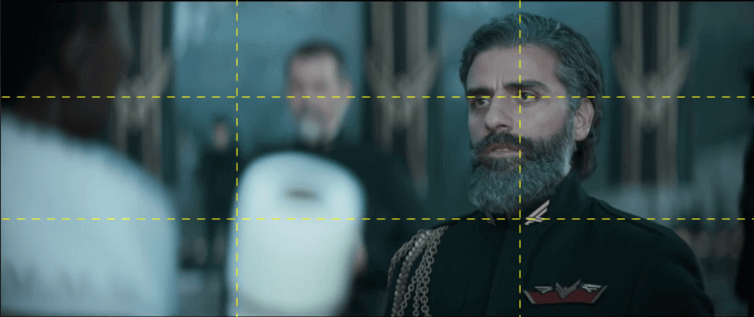
The overlaid grid marks the 3×3 division — place a subject or horizon on these lines (or their intersections) rather than dead-center for a more dynamic composition.
The rule of thirds is a simplified, camera-friendly approximation of the older painterly concept of the golden ratio (roughly 1:1.618), which produces a spiral-based division of a canvas rather than an even grid. Some cinematographers compose to the golden ratio directly for a subtler, less "gridded" balance point than thirds — both are guidelines to be broken deliberately, not fixed laws.
PrincipleDepth Staging
Arranging elements in the foreground, midground, and background gives a flat 2D frame the illusion of three-dimensional depth, and lets a cinematographer tell two things at once — for example, an eavesdropping character in the foreground while the real conversation happens behind them.
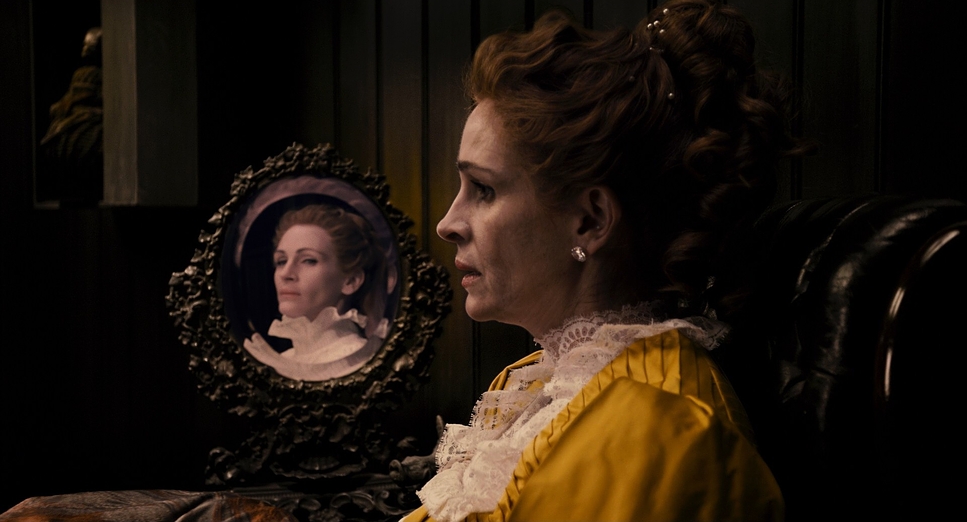
Foreground (closest to lens), midground (the main subject), and background (most distant) — each layer separates visually, adding depth even in a static frame.
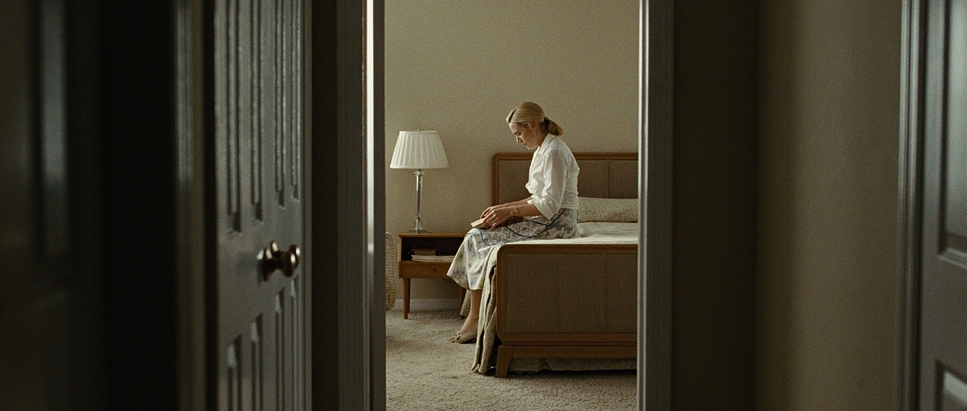
Frame Within a Frame
Using doorways, windows, mirrors, or architecture to create a "frame" around the subject inside the camera's own frame.
Effect: isolates the subject, suggests confinement/being watched, or emphasizes voyeurism.
PrincipleSymmetry, Balance & Framing Detail
Roads, railings, architecture, or shadows within the frame that visually guide the eye toward the subject or a key point of interest.
The empty space above a subject's head. Too much makes a subject look small and lost; too little feels cramped — the right amount depends on shot size and intent.
Extra space left in the direction a subject is facing or moving. Removing it (framing them tight against the edge they look toward) creates subtle unease or confinement.
Large areas of empty frame around a small subject. Conveys isolation, loneliness, or insignificance against environment.
Perfectly centered, mirrored compositions read as formal, controlled, or unsettling in their artificiality — a hallmark of directors like Wes Anderson and Stanley Kubrick, the latter known for rigorous one-point perspective corridors (e.g. The Shining, 1980).
Visual "weight" (size, brightness, color saturation) should usually be distributed so the frame doesn't feel like it's tipping to one side, unless imbalance is the intended effect.
Further Reading
- What Is Cinema? — André Bazin. The foundational essays on deep focus, mise-en-scène, and realist composition versus montage.
- Film Art: An Introduction — David Bordwell & Kristin Thompson. Standard textbook coverage of composition, staging, and the frame as a formal system.
- The Filmmaker's Eye — Gustavo Mercado. Frame-by-frame breakdowns of rule of thirds, leading lines, and framing-within-framing across many films.
- Composition chapters in Blain Brown's Cinematography: Theory and Practice (3rd ed., 2016). Ties composition directly to camera and lens mechanics.